

Our Product
Product Highlights
Over the past two decades, EUS-guided tissue acquisition has progressed from first-generation FNA needles, designed primarily for cytology, to second-generation FNB needles with basic core-capture features, and ultimately to third-generation FNB needles such as Franseen, Fork-tip, and SharkCore, engineered to obtain more intact core samples with improved histologic yield. Despite these design advancements, all existing needles rely on manual tissue acquisition technique.
Precision-GI™ brings the Next-Gen Endoscopic Ultrasound-Guided Biopsy featuring high-speed motorized tissue acquisition for cleaner, intact core samples with fewer passes.

Precision-GI™ uses a high-speed rotational cutting mechanism with controlled axial advancement. It produces a circumferential clean cut that preserves tissue architecture, in contrast to the fragmented tissue obtained by axial jabs and tissue tearing with manual needle technique.
In practice, that means cleaner, intact core samples available downstream for pathology, molecular and NGS testing.
Precision-GI™ is indicated for use* with an ultrasound endoscope (EUS) for biopsy of submucosal lesions, mediastinal masses, lymph nodes and intraperitoneal masses within or adjunct to the gastrointestinal tract.
*This indication is consistent with the device’s FDA 510(k) clearance (K231422).
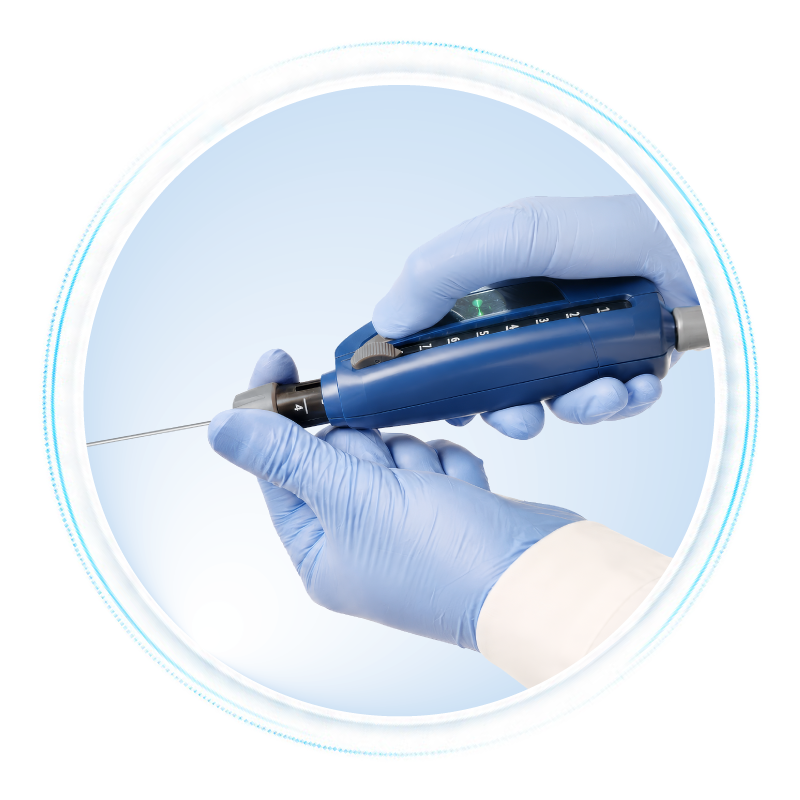
The Device
Precision-GI™ Components
Select a number to explore each part of the device.

Clinical Rationale
Redefining the Standard of Care in EUS Tissue Acquisition
Although EUS-FNB needles have improved EUS biopsy diagnostic capabilities, the shift towards histopathological analysis, molecular testing and genomic sequencing emphasizes the growing need for advanced technology designed to maximize tissue quality and procedural effectiveness.
~84%
EUS-FNB shows a pooled sensitivity of approximately 84 percent for malignant pancreatic lesions* which may lead to re-do cases
13%
This gap is especially critical in pancreatic cancer, which remains among the most lethal malignancies, with a five-year relative survival rate of 13%**
PRECISION-GI™
STANDARD OF CARE
PRECISION-GI™
✓
Larger and cleaner samples supporting adequacy for advanced diagnostic methods***
STANDARD OF CARE
✕
Tissue adequacy for advanced diagnostic methods is not always achieved
PRECISION-GI™
✓
Intact, circumferential cut with preserved tissue architecture
STANDARD OF CARE
✕
Non-uniform tissue samples with fragmented tissue pieces
PRECISION-GI™
✓
A super-elastic needle engineered for optimal access to challenging anatomic configurations, including the uncinate process, while ensuring no needle deformation
STANDARD OF CARE
✕
May be limited in accessing angulated positions and anatomically challenging configurations
PRECISION-GI™
✓
Efficient procedure with the motorized technique requires less than 1/10 of needle actuations ****
STANDARD OF CARE
✕
Time consuming procedure with repeated passes and actuations
PRECISION-GI™
✓
Controlled precise sampling through high-speed rotational tissue cutting mechanism
STANDARD OF CARE
✕
Repetitive axial manual needle stabbing
* https://www.nature.com/articles/srep22978
** https://www.cancer.org/cancer/types/pancreatic-cancer/detection-diagnosis-staging/survival-rates.html
*** Robles-Medranda, C., et al. (2025). Evaluation of a novel motorized EUS-guided fine-needle biopsy device and pathology quality parameters comparison to standard fine-needle biopsy: A prospective pilot study. Gastrointestinal Endoscopy, 101(5), S592–S593
**** Dornblaser DW, Khamaysi I, Gross SA. iGIE. 2023;2(2):126-130
MARKET SEGMENTS
Precision-GI™ Main Market Segments

Pancreatic Cancer
Pancreatic masses require a definitive diagnosis to begin patients’ treatment journey, yet obtaining a timely and accurate diagnosis can be challenging.
Precision-GI™ represents a differentiated, innovative approach to EUS-guided tissue acquisition, primarily indicated for biopsy and tissue sampling of pancreatic masses.

Liver Biopsy
Endoscopic ultrasound-guided liver biopsy (EUS-LB) is increasingly recognized as an attractive alternative to conventional percutaneous (PC) or transjugular (TJ) approaches, offering a minimally invasive, high-diagnostic-yield solution that enables endohepatologists to provide a “one stop shop” solution for patients with confirmed or suspected liver disease in need of liver biopsy.*
Reduced number of actuations with Precision-GI™ may minimize potential trauma to the liver, supporting consistent, high-quality tissue acquisition.
* Endoscopic Ultrasound-Guided, Percutaneous, and Transjugular Liver Biopsy: A Comparative Systematic Review and Meta-Analysis

Pipeline - Lung Cancer
Advanced procedures like Endobronchial Ultrasound (EBUS) enable minimally invasive access to critical central thoracic targets without requiring major surgery.
As clinical demand shifts toward comprehensive NGS testing and next-generation lung navigation systems, integrating Precision-GI™ with these advanced systems will support significant progress in providing accurate diagnostic for these patients leading to more efficient treatment.
GLOBAL MARKET OPPORTUNITY
>$1 Billion
1,275,000
Total Global Procedures, 2025*
Sources: EUS Needles Market - Global Industry Analysis and Forecast, 2017 to 2025 by Transparency Market Research (TMR); Global Liver Biopsy System Market 2020 to 2026 by 2020 Global Info Research (GIR). *These are procedures relevant to endoscopic biopsy.
850,000
Pancreatic Cancer
Global Procedures, 2025*
225,000
Liver
Global Procedures, 2025*
200,000
Lung Cancer
Global Procedures, 2025*